
• Home
  • About
  • Blog
  • Events
  • Media
  • Audio
  • Video
  • Glossary
  • Contact
  • Download
  • RSS

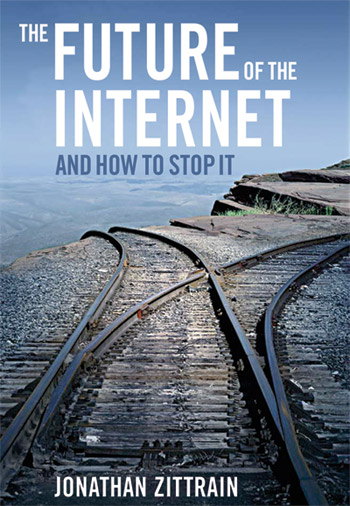
This extraordinary book explains the engine that has catapulted the Internet from backwater to ubiquity—and reveals that it is sputtering precisely because of its runaway success. With the unwitting help of its users, the generative Internet is on a path to a lockdown, ending its cycle of innovation—and facilitating unsettling new kinds of control.

IPods, iPhones, Xboxes, and TiVos represent the first wave of Internet-centered products that can’t be easily modified by anyone except their vendors or selected partners. These “tethered appliances” have already been used in remarkable but little-known ways: car GPS systems have been reconfigured at the demand of law enforcement to eavesdrop on the occupants at all times, and digital video recorders have been ordered to self-destruct thanks to a lawsuit against the manufacturer thousands of miles away. New Web 2.0 platforms like Google mash-ups and Facebook are rightly touted—but their applications can be similarly monitored and eliminated from a central source. As tethered appliances and applications eclipse the PC, the very nature of the Internet—its “generativity,” or innovative character—is at risk.

The Internet’s current trajectory is one of lost opportunity. Its salvation, Zittrain argues, lies in the hands of its millions of users. Drawing on generative technologies like Wikipedia that have so far survived their own successes, this book shows how to develop new technologies and social structures that allow users to work creatively and collaboratively, participate in solutions, and become true “netizens.”

Future of the Internet Blog

  • Could Edge-Caching Violate Net Neutrality?
  • Note: Brendan Ballou is solely responsible for the content of this article. It is not necessarily endorsed by Professor Zittrain Our little corner of the blogosphere has been lit on fire by the recent article in the Wall Street Journal claiming that Google was coming out against Net Neutrality. Now, there are plenty of problems with this article. Contra WSJ, to quote David Isenberg: “Google's edge caching isn't new or evil Lessig didn't shift gears on NN Microsoft and Yahoo have been off the NN bandwagon since 2006 The Obama team still supports NN Amazon's Kindle support is consistent with its NN support” This is all more ...
  • Creative Commons- the Past and the Future
  • By Yvette Wohn Creative Commons held a special panel and fundraiser on Friday featuring Board Chairman James Boyle, Stanford professor and CC founder Larry Lessig, CEO Joichi Ito, and former Executive Director Molly S. Van Houweling. The event kicked off with HLS Dean Elena Kagan announcing Lessig's return to Harvard (in fall 2009) and an introduction by Charlie Nesson. Jonathan Zittrain- moderating the session- then zoomed in with his first question: where did Creative Commons start? Everyone seemed to agree that CC was a collaboration of bits of ideas from several people, and that the concept evolved over many meetings. Zittrain insisted ...

Blog Archives

  • December 2008 (8)
  • November 2008 (7)
  • October 2008 (4)
  • September 2008 (1)
  • August 2008 (10)
  • July 2008 (11)
  • June 2008 (2)
  • March 2008 (1)
  • November 2007 (2)
  • February 2007 (1)


Creative Commons BY-NC-SA Jonathan Zittrain unless otherwise noted.
Powered by WordPress using Gridline Lite.